Why Are My Gooseberry Leaves Covered in Orange Pustules?
Orange, yellow, or rust-coloured pustules or cup-shaped structures appearing on the underside of gooseberry leaves — sometimes with corresponding yellow patches on the upper surface — are the characteristic sign of cluster cup rust (Puccinia caricina or related species). This fungal disease requires two different host plants to complete its life cycle: it spends one phase on gooseberries or currants, and another on sedge plants (Carex species) growing nearby.
Quick Summary: Orange spots and pustules on gooseberry leaves indicate cluster cup rust. This fungus cannot survive without sedge plants nearby. Removing all sedges within 100 meters breaks the rust cycle, and applying a sulfur fungicide at spring bud burst protects your bushes.
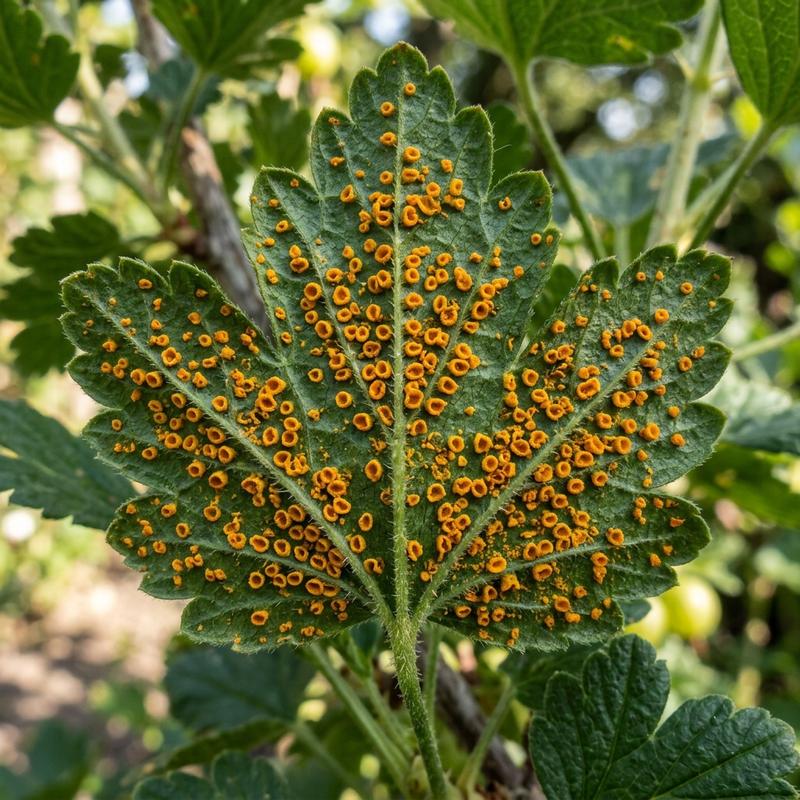
Identifying cluster cup rust
The initial symptoms on gooseberry leaves are pale yellow or orange spots on the upper leaf surface, appearing from May or June onwards. On the underside of the leaf, orange-yellow cup-shaped pustules develop at these same spots. These cups split open to release a cloud of orange spores. Heavily infected leaves may show numerous pustules covering large areas of the leaf surface, leading to premature yellowing and leaf drop. Fruits and leaf stalks can also be infected in severe outbreaks.
The two-host life cycle
Understanding the rust life cycle helps explain why management on the gooseberry alone is insufficient. The fungus produces one type of spore on gooseberries that infects sedge plants, and a different type on sedges that infects gooseberries. Without sedge plants nearby, the disease cannot complete its cycle and the level of infection in subsequent seasons drops substantially. Wet springs with high humidity favour infection, as spores require moisture to germinate and enter leaf tissue.
Removing sedge hosts
Inspect the area within 100 metres of your gooseberry bush for sedge plants — particularly on wet ground, pond margins, or shaded damp areas. Carex species are grass-like plants that are common in damp gardens. Removing sedge clumps entirely from the immediate area breaks the rust cycle effectively. This is more practical in smaller gardens; in larger open settings or near natural watercourses it may not be fully achievable.
Managing the bush
Remove and destroy affected leaves as soon as you spot the pustules, before they open and release spores. Pick up any fallen infected leaves from beneath the bush. A sulphur-based fungicide applied preventively from bud burst in spring, repeated at fourteen-day intervals through the main infection period, can reduce the severity of infection on the bush even if complete control of the sedge host is not possible. Improving air circulation through annual pruning also helps.
Severity and crop impact
Cluster cup rust is less damaging to the crop than American gooseberry mildew or heavy leaf spot infection in most seasons, as it primarily attacks the leaves rather than the fruit. In a mild outbreak the fruit crop is largely unaffected and the main consequence is early defoliation that weakens the bush slightly. Only in severe outbreaks — common in very wet springs — does the rust cause significant fruit damage or heavy crop losses.